
The American 2 Party System is for Dummies
Since the dawn of the United States there has been partisan bickering been two primary parties–a trend that has never really changed. This division in politics was likely a remnant of the old British system of rule and the conflict that existed between the Tories and the Whigs in Revolutionary times. Regardless of the history which is no doubt long and tedious, (and way too complex for this blogger) since as far back as the first Congress in 1789 there were two primary parties (see http://en.wikipedia.org/wiki/Party_divisions_of_United_States_Congresses). At that time these parties were the Anti-Administration and Pro-Administration parties (they weren’t all that clever with names back then) which then became the Democratic-Republicans and Federalists in the 4th Congress (1795, remember each Congress takes up 2 calendar years). From there it was the Democrats and National Republicans (1825), Democrats and Whigs (1837), and finally Democrats and Republicans starting in 1855. In fact, since 1855 the seats in the House and Senate have been filled with either a Democrat or a Republican 99.06% of the time and the presidency has never been filled by a third party.
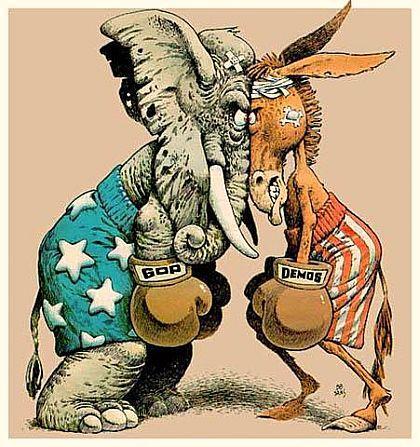
You might wonder why we have two parties but don’t strain your mind–it’s actually not that hard to figure out. The fact is we have two of a lot of things for a very good reason: it’s easier. Think Coke and Pepsi, Apple and Android, Pampers and Huggies; the fact is the human brain likes to make decisions based on comparisons and it’s really hard to evaluate three or more items. I know it sounds simplistic but I think it’s just that easy: Americans are too lazy to do a lot of research so they prefer either/or decisions–Republican or Democrat is way easier than deciding Joe Smith, John Doe, Suzy Salamander, or Willis Winkleman.
My assertion in the title that the two-party system is for dummies is not intended to be an editorial judgement on the merits of our political process–I actually like it that way as it makes it easier to assign responsibility to the group that is messing things up in the country. I just happen to think that the American electorate pays little attention to the individual views and positions of the candidates and we find it easier to make decisions based on a generic title. Like it or not the two-party system is here to stay so if you want to feel represented, make your choice and if you’re not too picky on policy it can be just as easy as a flip of a penny; heads for a Lincoln Republican or tails for . . . the other guys.
O’Dowd

 O'Dowd Politics