
The American 2 Party System is for Dummies
Since the dawn of the United States there has been partisan bickering been two primary parties–a trend that has never really changed. This division in politics was likely a remnant of the old British system of rule and the conflict that existed between the Tories and the Whigs in Revolutionary times. Regardless of the history which is no doubt long and tedious, (and way too complex for this blogger) since as far back as the first Congress in 1789 there were two primary parties (see http://en.wikipedia.org/wiki/Party_divisions_of_United_States_Congresses). At that time these parties were the Anti-Administration and Pro-Administration parties (they weren’t all that clever with names back then) which then became the Democratic-Republicans and Federalists in the 4th Congress (1795, remember each Congress takes up 2 calendar years). From there it was the Democrats and National Republicans (1825), Democrats and Whigs (1837), and finally Democrats and Republicans starting in 1855. In fact, since 1855 the seats in the House and Senate have been filled with either a Democrat or a Republican 99.06% of the time and the presidency has never been filled by a third party.
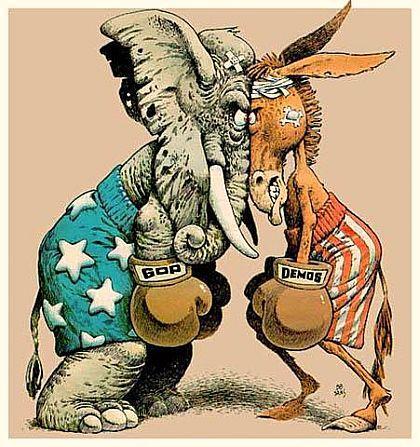
You might wonder why we have two parties but don’t strain your mind–it’s actually not that hard to figure out. The fact is we have two of a lot of things for a very good reason: it’s easier. Think Coke and Pepsi, Apple and Android, Pampers and Huggies; the fact is the human brain likes to make decisions based on comparisons and it’s really hard to evaluate three or more items. I know it sounds simplistic but I think it’s just that easy: Americans are too lazy to do a lot of research so they prefer either/or decisions–Republican or Democrat is way easier than deciding Joe Smith, John Doe, Suzy Salamander, or Willis Winkleman.
My assertion in the title that the two-party system is for dummies is not intended to be an editorial judgement on the merits of our political process–I actually like it that way as it makes it easier to assign responsibility to the group that is messing things up in the country. I just happen to think that the American electorate pays little attention to the individual views and positions of the candidates and we find it easier to make decisions based on a generic title. Like it or not the two-party system is here to stay so if you want to feel represented, make your choice and if you’re not too picky on policy it can be just as easy as a flip of a penny; heads for a Lincoln Republican or tails for . . . the other guys.
O’Dowd
 O'Dowd Politics
There is a lot of sense to that post. It is easier. Who could figure out and keep up with Israeli politics? Even the press don’t pretend to understand it. But our two-Party system could work to the good like two people competing. Instead it has been the exact opposite much of time. (until lately) So that they both get worse and more corrupt rather than better. It would be nice if it worked the other way – especially now. It became just the resented two-headed duopoly. And they do make all the rules.
Thanks for the comment! Here is the benefit of a two-party system: nothing gets done if there’s too much division. This protects the country from knee-jerk reactions and violent swings in policy. Also, big ideas can become reality whereas in a multiple party system only moderate ideas get heard and acted on as there has to be either consensus or a coalition to bring ideas through. While this may seem to be better, real change can be impossible to achieve as big ideas get ignored. Also, if the economy is lousy and the Republicans are in control it’s easy to see who’s at fault and punish them by taking away their power. If there were five parties, it would be impossible to assign blame and there would be less accountability at election time. The other benefit is that there is certainty regarding what policies will be supported by the government because it is easy to see who is in control. In a parliamentary system with multiple parties there has to be a sometimes lengthy process between multiple parties to form a coalition to establish leadership. During these negotiations oftentimes principles and positions have to be laid aside or scrapped altogether in order to reach agreement. Of course, there is also the chance that a coalition cannot be formed and no majority can take the lead as well…
O’Dowd
I’d contend that the cause for our two party system is tied more to how we have chosen to elect candidates. We have a single-member district (SMD) congressional system which means that every represented district gets to elect exactly one candidate (at least for the House), and this system is basically represented at every level in American politics (obviously the US Senate is slightly different, but not by a lot).
SMD systems promote two party control because of the math. If there were a third party which was just slightly less popular than the other two, it still may not get any seats. Consider a system where the total population was spread across Party A, B, and C in a 35/35/30 split. If the population is evenly divided across geography, parties A and B will fight over each district with some falling one way and some falling the other. Despite a 30% stake in the popular opinion, Party C will end up winning 0 seats and be completely unrepresented. Ultimately, people in Party C will end up joining up with A or B because they are completely disenfranchised with Party C. The equilibrium of this math is what leads us to a two party system and keeps us there.